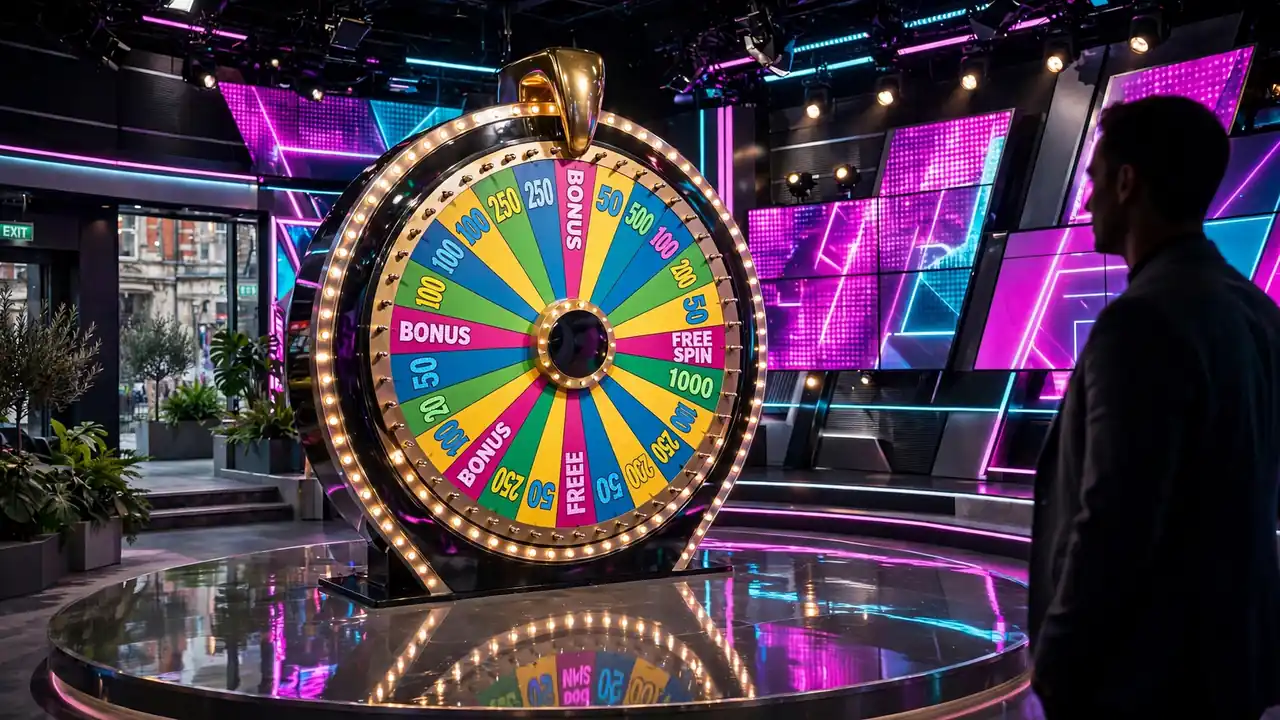
Crazy Time Live Casino in the UK: What to Know
 Available in GB
Crazy Time is one live game-show title within an online casino, a broader service that can offer several kinds of games.
Table of Contents
- How Crazy Time Fits into the UK Live-Casino Market
- Checking a Casino’s UK Licence Before Depositing
- Finding Crazy Time on an Online Casino
- Where Live Casino Games Sit in a Casino’s Offering
- Choosing a Casino Without an Unsupported “Best” Ranking
- Crazy Time Strategy: What the Available Evidence Can Support
- Free Play, Demos and the Limits of the Available Information
- Bonuses, Deposits and UK Account Safeguards
- Rules, Scores and Multipliers: What Can Be Verified
How Crazy Time Fits into the UK Live-Casino Market
Crazy Time is discussed as a live-casino game-show title, a category that sits within the wider online casino rather than describing the whole casino experience. The distinction matters: a casino may provide several kinds of games, while a particular live title is one part of that broader selection. The phrase “Crazy Time live casino” therefore refers to a specific game in a live-casino setting, not to a separate type of gambling venue.
The game-show framing also sets it apart from familiar live casino categories such as card games and roulette. A useful UK-market point of comparison is Grosvenor, which introduced live casino games in 2013 with a selection that included Blackjack, Texas Hold’em and Roulette. That history illustrates that live casino has encompassed more than one format; it does not establish that every operator offers the same titles or that Crazy Time is available in every live-casino lobby.
For someone trying to understand the subject, it helps to keep three terms separate. An online casino is the service or account environment; live casino is a category within its games; Crazy Time is the named title being considered. These labels are related, but they are not interchangeable. Mention of a UK Crazy Time casino, for instance, may concern an operator’s overall service, while the actual game is only one possible component of its catalogue.
The game-show description is a way of identifying the title’s presentation and category. It should not, on its own, be treated as a description of particular rules, outcomes, or betting options. Those details require game-specific information and are separate from the broader point that Crazy Time is discussed as a live-casino game show. This distinction avoids reading more into a category label than it can support.
Likewise, the existence of a live-casino section does not establish that a given casino includes Crazy Time. A broad catalogue may contain different live titles, and availability is an operator-specific question. That practical issue is separate from what the title represents within the market: a named game-show product in the live-casino category, rather than a synonym for all live casino games. The distinction is useful when comparing general descriptions of a casino with information that refers specifically to Crazy Time.
Deal or No Deal Casino UK: Slots and Offers
This context does not imply that the title is suitable for every player or that its format changes the financial risks of gambling. Casino play can result in losses, and only money that can be afforded to lose should be put at risk. Category labels describe how a game is presented within a casino’s offering; they do not establish likely results or make any outcome predictable.
Our top casino picks for the UK
- BritsinoBonus: Welcome Package – Get your £2,200 + 2,000 FS · Payout speed: 1-3 business days
- ZombillionBonus: Welcome Pack 250% up to £4000 + 200 FS · Payout speed: 1-3 business days
- EvoSpinBonus: 125% up to €2500 + 125 Free Spins · Payout speed: 1-3 business days
- Revery PlayBonus: 100% up to€1,000+ 100 FS · Payout speed: 1-3 business days
- NightLuckBonus: Welcome Pack + 805% Up To 6400€ + 280 FS · Payout speed: 1-3 business days
- DieselwinBonus: Welcome Pack 250% up to £4000 + 200 FS · Payout speed: 1-3 business days
Checking a Casino’s UK Licence Before Depositing
A casino’s licence is a separate question from whether Crazy Time appears in its games catalogue. For a UK player considering real-money play, the relevant issue is whether the business operating the casino is authorised to serve the market. A game’s presence on a website, or a claim that it is available to British customers, does not establish that the operator holds the required licence.
The UK Gambling Commission oversees gambling activity across the United Kingdom, including online casinos. For remote gambling offered to consumers in Great Britain, the operator must hold the appropriate Commission licence even if its equipment or business premises are located elsewhere. In Great Britain, the Commission is the regulator responsible for commercial gambling. This makes the operator’s regulatory status—not the location of a live studio or the technology behind a game—the central point to establish before depositing.
What the licence applies to
The Commission issues operating licences to businesses and personal licences to individuals working in relevant gambling roles. These are different forms of authorisation: a personal licence does not substitute for the operating licence needed by a casino business serving customers. When assessing an online casino, the question is therefore whether the business behind the service has an operating licence appropriate to the gambling it offers.
This distinction matters where a website presents a familiar brand, game title or provider name prominently. Those details do not, by themselves, identify the licensed business. Nor does a company’s registration in another country demonstrate permission to provide remote gambling to consumers in Great Britain. The requirement follows the service being offered to the market, not simply the jurisdiction in which the operator says it is based.
Attention: A company’s registration in another country does not demonstrate permission to provide remote gambling to consumers in Great Britain.
The UK and Great Britain are not interchangeable in every legal context. The Commission’s stated remote-gambling requirement applies to services offered to consumers in Great Britain. Its wider regulatory role covers gambling activity in the United Kingdom, including online casinos. Careful wording matters because a licence check should relate to the actual operator and the relevant market, rather than relying on a general claim that a site is “regulated”.
How to check the operator
The Commission’s public register is the primary place to verify a business’s authorisation. The check should begin with the legal name of the company operating the casino, rather than only the website’s branding. If the site identifies more than one business, it is important to establish which entity takes responsibility for the gambling service. A licence belonging to an unrelated company is not evidence that the casino itself is authorised.
The register can then be compared with the casino’s own licensing information. Names and web addresses should correspond closely enough to make clear that the listed business is connected to the site in question. A logo, licence badge or statement on a casino page is a claim made by the operator; it is not a substitute for checking the Commission’s public record. Where the identity of the business or its relationship to the website remains unclear, the licence claim should not be treated as confirmed.
A specialist review reports that a check of the public Gambling Commission register dated 26 September 2026 did not identify a LuckyPays entry under that brand or its stated domain, including luckypays.io. This is a dated report about a register search, not a general finding about other casinos or a permanent statement of an operator’s status. Register information can change, so any decision should be based on a direct check of the Commission’s current public register rather than on an older third-party account.
Crash Casino Games in the UK: Categories and Access
What a licence check establishes
A matching operating-licence entry provides evidence that the named business is authorised by the regulator for the activities covered by its licence. It does not establish that every game advertised on the casino is available to every account, nor does it resolve other questions about a particular game. Those are separate matters from whether the operator may legally provide remote gambling to consumers in Great Britain.
The reverse is also important: a website’s accessibility from the UK does not prove that it is licensed to serve the market. The licensing requirement concerns the operator offering the service, including when its key equipment is outside Great Britain. A check should therefore be based on the Commission’s record and the identity of the business behind the casino, not on the site’s language, branding or apparent availability.
For a casino advertising Crazy Time, the relevant verification is the same as for any other online gambling service: establish the operating company and confirm its authorisation with the UK Gambling Commission before depositing. That keeps the regulatory question distinct from the separate question of whether the game is included in the casino’s offering.
Finding Crazy Time on an Online Casino
A search for a Crazy Time online casino can mean two different things: a gambling website that offers casino games, or the Crazy Time game available within that website’s catalogue. The distinction matters because finding a casino’s homepage does not, by itself, confirm that the game is part of its current offering. Availability is a property of the casino’s catalogue, not of the phrase used to describe the site.
Checking Game Availability
Use the search function
Enter “Crazy Time” into the casino’s search tool to see if a matching title is listed.
Browse categories
If no search tool exists, browse the catalogue by game type or provider to locate the listing.
Verify the result
Ensure the result is a direct route to the game itself rather than an article, review, or advertisement.
A practical check starts with the casino’s own game listings. If the site has a search function, entering “Crazy Time” can show whether a matching title is listed. If there is no useful search, the catalogue may be arranged by game type or provider; browsing those categories can help locate a listing. The site’s own description should be checked rather than relying on a general web result, since a result may refer to a different casino, an outdated page or a promotional article rather than a playable game.
Confirm the game listing
A result that mentions Crazy Time is not necessarily a route to the game. It might be an article, a review, an advertisement or a page about another product. The distinction is especially relevant when a site uses broad wording such as “live casino”: that label describes part of a casino’s offering, but it does not establish that every particular title is included.
A listed game should be identifiable by its name within the casino’s own environment. Where a title appears in more than one place, the relevant entry is the one that opens the game itself, rather than a general information page. A casino may also show a game as unavailable or require a sign-in before displaying its full catalogue. In that situation, the visible listing and the actual ability to open the game are separate questions.
Search wording can be kept simple. “Crazy Time” is more useful within a casino catalogue than a long phrase combining the game name with “online casino”. A broader web search may help locate a casino’s official website, but the casino’s catalogue is the more direct place to check whether Crazy Time is offered there. Similar wording across websites does not establish that they are connected or that they provide the same games.
Online Casino Games for Real Cash in the UK
Distinguish the site from access to the game
An online casino is the wider service through which games may be presented. Crazy Time, when offered, is one title within that service. This means that a casino can exist without listing the game, and a page about the game can exist without being the casino service that provides access to it.
The route into a game can also depend on the site’s own account process. A visitor may be able to view some catalogue information before signing in, while access to a playable title may be handled within an account. The exact layout and sequence are determined by the individual operator, so a button, preview or information page should not be mistaken for confirmation that a session has opened.
Before depositing, operators must verify a customer’s age. Online gambling is legal in the UK for people aged eighteen and over when it is provided by an operator holding a UK Gambling Commission licence. The question of whether a casino lists Crazy Time is therefore distinct from whether the operator is authorised to serve the market; the latter should be checked separately before funds are deposited.
Avoid relying on a name alone
A casino’s name in a headline or search result is not sufficient proof of current availability. The most direct indication is a matching title in the casino’s own catalogue, accompanied by a route that opens the game. If the listing cannot be found, the casino’s general live-casino label should not be treated as confirmation.
Do
- Look for a matching title in the casino’s own catalogue
- Confirm the listing provides a route that opens the game
Don’t
- Rely on a brand name in a headline or search result
- Treat a general live-casino label as confirmation of availability
Availability can also be confused with access conditions. A game may be visible in a catalogue but not open until the site’s account requirements have been met. Conversely, a page may describe a game without showing whether it can currently be accessed through that operator. Checking the listing and the access route separately keeps these claims distinct.
A casino’s presence online does not make every game searchable through the same menus, and no single navigation path applies across all sites. The useful outcome is a direct match between the casino’s own listing and the game that opens, rather than an assumption based on a brand name or a broad category. Gambling carries financial risk; only money that can be afforded to lose should be wagered.
Where Live Casino Games Sit in a Casino’s Offering
An online casino may present live casino games as one part of a broader catalogue, alongside other types of casino games. Within that category, individual titles can be grouped by provider, format or game name, depending on how the operator has organised its site. These arrangements are not uniform, so the presence of a live-casino section does not establish that a particular title, including Crazy Time, is available there.
Grosvenor offers a documented example of how live games can form part of an operator’s wider selection. It introduced live casino games in 2013, with card and casino titles that included Blackjack, Texas Hold’em and Roulette. That history shows a live-casino range being presented as part of a larger casino offering; it does not establish that Crazy Time was among those games or that it is currently available through Grosvenor.
Casino Dice Games in the UK: Rules and Online Play
The distinction matters when considering where a live game can be played. A casino brand is the operator’s overall service, while a live-casino range is one component of its catalogue. A particular game is narrower still: it may appear within that range only if the operator carries it. Consequently, a casino’s general promotion of live games is not enough to confirm access to Crazy Time.
How a live-casino catalogue can be organised
A casino site may provide a dedicated live-casino area, a general games catalogue, or both. Titles might be found by browsing categories or by using a site’s own search tools, where available. The labels and layout can differ between operators, and a title’s location can change as a catalogue is updated. These are practical ways to approach a catalogue, not a guarantee that any specific operator carries the game.
The wording used for a title can also shape how it appears in a catalogue. A search for Crazy Time may be more precise than browsing a broad live-games category, but the site’s results still need to be interpreted as an indication of that operator’s current listing. A general category label, such as “live casino”, describes a part of the offering rather than confirming the presence of every live title.
Terms such as “wheel” may appear in descriptions or labels associated with a game. On their own, they do not establish the game’s rules, format or availability at a particular casino. Those details should not be inferred from the category in which a title appears or from a search result snippet.
Terms such as “wheel” in descriptions do not establish the game’s rules, format, or availability at a particular casino.
For the same reason, a list of live games on an operator’s site should be treated as specific to that operator, rather than as a complete account of the wider market. An example such as Grosvenor’s live range documents one operator’s introduction of live games, but does not verify a market-wide directory or establish where Crazy Time can currently be played.
The most reliable conclusion from a casino catalogue is therefore limited: it can show whether that operator lists a named game at the time of checking. It cannot, by itself, establish that the same title appears across other casinos or that a similarly named category contains it. Any gambling should be limited to money that can be afforded to lose.
Choosing a Casino Without an Unsupported “Best” Ranking
A claim that a casino is the “best” place to play Crazy Time needs a stated basis for comparison. Without comparable evidence about the game’s availability, account conditions and operator safeguards, a ranking is an opinion rather than a reliable assessment. A prominent listing or promotional description alone does not establish that a casino is suitable.
A more grounded comparison begins with the operator behind the site. Remote operators serving consumers in Great Britain are required to hold the relevant Gambling Commission licence. The licence should be checked against the operator’s identity on the Commission’s public register before depositing; a familiar brand name or a badge displayed on a website is not a substitute for that check. Where the operator cannot be matched clearly to a current licence, its suitability for a British player remains unestablished.
Mines Casino Game UK: What the Evidence Shows
Compare the conditions, not the label
The presence of Crazy Time is only one part of an assessment. Site descriptions can change, and a game being mentioned in promotional material does not by itself confirm that it is currently available to a particular account. The casino’s own game listing and terms are more relevant to availability, while the operator’s identity and licence status concern whether the site is authorised to serve the market. These are separate questions and should not be treated as interchangeable.
Claims about Crazy Time casino bonuses also require careful reading. A headline offer cannot be assessed on its stated value alone: the applicable terms determine eligibility and how the offer can be used. Terms may differ between operators and can change. No general ranking follows from the existence of a bonus, and an offer should not be treated as evidence that a casino provides better access to the game or stronger player protection.
Likewise, searches for casino results associated with Crazy Time should not be taken as a measure of operator quality. A result or outcome relates to a game event; it does not demonstrate that the casino is properly licensed, that its account conditions are clear, or that its safeguards are adequate. Assessments of outcomes and possible strategies require game-specific evidence and are a separate matter from choosing an operator.
Look for usable safeguards
Account controls provide another practical point of comparison. UK-licensed casinos must offer responsible-gambling tools, including self-exclusion, and remote operators must make account-level financial limits accessible. New customers must be prompted to set a financial limit before making a first deposit. Their presence does not guarantee that gambling will be risk-free, but clear access to these controls is a relevant feature when comparing sites.
Casino Suitability Check
- Verify the operator’s identity on the Gambling Commission’s public register
- Confirm the business holds a current operating licence
- Ensure access to responsible-gambling tools like self-exclusion
- Check that a financial limit prompt is provided before the first deposit
- Confirm the operator does not accept credit cards for gambling
Other basic requirements also matter. Operators must verify a customer’s age before allowing a deposit, and UK-licensed casinos cannot accept credit cards for gambling. Licensed operators must provide an internal complaints process and access to an approved alternative dispute resolution service. These obligations are more informative than a vague claim of being a leading Crazy Time casino, although they do not replace checking the specific operator’s licence and terms.
No defensible “best Crazy Time casino UK” ranking can be made from a game listing, bonus headline or isolated result alone. A cautious assessment rests on verifiable operator identity, a current licence, clear terms and accessible account safeguards. Gambling carries a risk of loss; only money that can be afforded to lose should be wagered.
Crazy Time Strategy: What the Available Evidence Can Support
A credible Crazy Time casino strategy would need to rest on information about the game’s rules, outcome-generation process and relevant results. Without reliable, game-specific evidence of that kind, claims that a particular wager pattern, timing choice or sequence improves the chance of success cannot be treated as established. A strategy may describe a player’s preferred approach, but that is not the same as demonstrating an advantage.
This distinction matters because a system can sound methodical without being supported by evidence. Changing a wager after a win or loss, for instance, is a decision about stake management; it does not by itself show that later outcomes become more favourable. Nor does a record of previous results demonstrate that an outcome is due. Such conclusions would require a justified account of how the game produces results and data capable of testing the claim.
Chicken Road Game Casino UK: What to Know
What a tracker can and cannot show
A Crazy Time casino tracker may present past results in an organised format. If the underlying entries are accurate, a tracker can help describe what has already been recorded. It cannot, on that basis alone, establish what will happen next. A sequence, streak or apparent pattern in historical results is not proof of a predictive signal.
The same caution applies to a casino tracker for Crazy Time in the UK. The location of a website or the fact that it displays results does not verify the accuracy, completeness or predictive value of its records. To assess a tracker’s claims, relevant questions include how its data are collected, whether entries can be checked against an independent record, and whether the proposed method has been tested on results beyond those used to create it. Without such support, a tracker is best understood as a record-keeping tool, not a forecasting system.
Searches for the game’s casino history raise a related issue. Historical information about a product can establish when or how it was introduced only where dependable documentation supports those details. It does not, by itself, reveal a strategy for wagering or show that past results can forecast future ones. A product’s history and the statistical behaviour of its outcomes are separate subjects.
Evaluating strategy claims
Claims about a Crazy Time live casino strategy should therefore be assessed by the evidence they offer, rather than by confident wording or elaborate charts. A persuasive claim would need to define the method clearly, identify the data used and explain how its performance was evaluated. It would also need to distinguish results observed in a sample from outcomes expected in future play. Without that basis, assertions of improved odds or dependable returns remain unsubstantiated.
Risks of Strategy
No strategy or tracker can guarantee a result or influence the outcomes of the game.
No strategy should be presented as a guarantee. Even a method supported by historical analysis would not ensure a particular result for an individual session. A tracker’s visual summaries, a player’s personal experience or a published system may all encourage pattern-finding, but none substitutes for a sound test of the claim.
The defensible position is consequently limited: records can describe recorded outcomes, while a strategy’s predictive value requires separate evidence. Where that evidence is absent, no specific Crazy Time casino game strategy can be recommended as a proven way to influence results. Gambling should be limited to money that can be afforded to lose.
Free Play, Demos and the Limits of the Available Information
“Free play” can describe different things: a version of a game that does not use real-money wagers, a promotional offer, or access to a game through a casino account. These are not interchangeable. A demo, if offered, would concern how the game can be played; free spins or other casino promotions are offers with their own terms. Treating them as the same feature can make a listing difficult to interpret.
For Crazy Time, the distinction matters when assessing claims of free access. A page advertising a free game may refer to a demonstration, a promotional route, or content that is available only after signing in. The label alone does not establish whether a session involves a real-money wager, whether an account is needed, or what restrictions apply. Those details need to be clear in the casino’s own description before the offer can be understood.
Live Dream Catcher Casino UK: What to Verify
The same caution applies to searches for Crazy Time free spins. The phrase suggests a specific promotional benefit, but it does not establish that such an offer is available, that it applies to this game, or that it can be claimed in the UK. A casino bonus and a free-play demo are different propositions: one concerns an operator’s promotion, while the other concerns access to a game without a real-money wager. Neither should be inferred from a vague “play free” label.
A casino review can help organise information, but its wording should be checked against the operator’s actual terms and game listing. Reviews may use “free” broadly, or refer to an offer that has changed. A useful assessment identifies what the claimed access involves, whether it requires an account, and whether any conditions are attached. Without those particulars, a statement that Crazy Time is free to play has limited practical meaning.
The same standard applies to descriptions of a safe Crazy Time casino. “Safe” is not a feature of a demo or a free-spin offer, and the phrase by itself does not explain what protections apply. Any assessment of an operator belongs alongside evidence about its status and account safeguards, rather than being treated as a consequence of free access. Promotional language cannot establish that a game session is risk-free or that an offer has no conditions.
A demo should also not be treated as evidence about real-money play. It may allow a person to explore a game interface, but it does not, by itself, establish how a casino handles deposits, withdrawals, account controls or complaints. Conversely, a casino promotion does not show that a separate demo version exists. Each claim needs to be read according to what it actually describes.
Distinguishing Free Access
Free play can refer to a demo version (playing without real-money wagers), a promotional offer (such as free spins with specific terms), or access available only after signing into an account.
For a clear account of any free option, the operator’s wording should specify whether the offer is a demo or a promotion, what access is required, and which terms govern it. If those points are not stated plainly, the label should not be taken as proof of a particular way to play. Regardless of whether access is described as free, anyone who chooses to gamble should only wager what they can afford to lose.
Bonuses, Deposits and UK Account Safeguards
A Crazy Time casino bonus may be presented alongside an offer for a casino account, but the existence of a promotion does not establish that it applies to the live game. Terms can specify which games or wagers count, so the offer conditions matter more than the label. No particular welcome bonus, deposit bonus, no-deposit offer or payout arrangement can be assumed for every casino offering Crazy Time.
Deposit methods are subject to UK safeguards. Remote gambling operators must not accept credit-card payments for gambling, including payments routed through a money service business. They must also reject wallet payments where credit-card funds can be used for gambling. A payment method appearing on an account page is not, by itself, confirmation that it can lawfully fund gambling.
Account controls apply before and after a first deposit. Operators must verify a customer’s age before allowing deposits into a gambling account. New customers must also be prompted to set a financial limit before making their first deposit, and account-level limit controls must remain accessible. These measures are relevant when reviewing a casino offer: a promotional deposit does not remove the requirement for age checks or financial controls.
A search for a Crazy Time casino no-deposit bonus, including one described as available in the UK, should not be treated as evidence that such an offer exists or that it can be used on this game. The same distinction applies to a welcome or deposit bonus: eligibility and game coverage depend on the operator’s stated terms. Bonus wording should not be read as a promise of winnings or payouts.
JetX Casino Game in the UK: Access and Status
The phrase “not on GamStop” describes an exclusion from that scheme, not an account safeguard. Where gambling is causing harm, promotional access is not a substitute for support or self-exclusion. In all cases, only gamble what can be afforded to lose.
Rules, Scores and Multipliers: What Can Be Verified
A useful account of Crazy Time’s rules needs to distinguish the game’s own instructions from general descriptions of live casino games. Terms such as “score” and “multiplier” can suggest a fixed calculation, but their meaning depends on the specific game rules. They should not be treated as evidence of a particular result or return.
The rules are the appropriate place to establish what a wager relates to, how a round is resolved and whether any stated multiplier applies. A multiplier, where described, is not by itself a promise of a payout: its effect depends on the conditions set out in the game’s rules. The same caution applies to scores. A score label should not be read as a running tally, a prediction or a measure of likely success unless the game’s instructions define it that way.
Descriptions of Crazy Time casino rules can be incomplete when they rely on promotional summaries or informal explanations. A clear explanation should identify the relevant terms and conditions rather than imply that a familiar label has a universal meaning. The presentation of a live game, including its show format, does not establish how a particular wager is settled.
The word “trusted” also needs careful use. A polished interface or confident explanation does not establish the accuracy of claims about rules, scores or multipliers. Game information should be assessed by its specificity and consistency with the instructions attached to the game, rather than by promotional language.
No scoring term or multiplier should be used as a basis for assuming an outcome. Gambling outcomes are uncertain, and no interpretation of game terminology removes that uncertainty. Anyone choosing to gamble should stake only what they can afford to lose.
Are online casino games licensed and regulated?
Yes. The UK Gambling Commission regulates online gambling in the UK, and operators serving consumers in Great Britain must hold the relevant operating licence.
What are the online slot stake limits in Great Britain?
The limit is £5 per game cycle for adults aged 25 and over, and £2 for adults aged 18 to 24. These limits do not apply to roulette or blackjack.
Is LuckyPays licensed by the UK Gambling Commission?
The Commission’s public register dated 26 September 2026 has no entry under the LuckyPays brand or the stated domain luckypays.io. Check the register under the legal name of the business operating the casino as well.
Prepared by the Betti Casino editorial staff.