Betti Casino Payment Methods: Deposits, Crypto and Withdrawal Times
 Available in GB

Table of Contents
- The payment page tells you more about an offshore casino than the bonus does
- Deposit methods and how they actually differ
- The minimum deposit and why the headline number misleads
- Crypto payments, without the hype and with the context
- The withdrawal process, step by step
- Withdrawal times, the realistic version
- Verification and limits, the gatekeepers of a clean payout
The payment page tells you more about an offshore casino than the bonus does
If you give me five minutes with a casino’s payment methods and withdrawal terms, I can tell you more about how it will treat you than any bonus banner ever could. I learned this the slow way, by watching players choose casinos on the strength of a match percentage and then discover, at the only moment that mattered, that getting their own money back was the hard part. Deposits are always easy. Casinos want your money in. Withdrawals are where the real character of an operator lives, and at an offshore brand like Betti, the payment infrastructure deserves a careful read before you fund anything.
What follows is the operational walkthrough I wish more people did before depositing. It covers which deposit methods Betti supports and how they differ in practice, what the minimum deposit really is and why that number is less simple than it looks, how crypto fits in without the hype that usually surrounds it, the withdrawal process step by step, and the realistic timelines you should actually expect rather than the optimistic ones the marketing quotes. The verification and limits that quietly govern whether a withdrawal clears on time or stalls sit alongside all of that.
A bit of market context frames why payments matter so much here. The online segment of UK gambling is enormous, with remote gaming yield reaching £7.8 billion in the 2024 to 2025 financial year after rising 13.1%, which tells you how much money is moving through these payment rails every day. Offshore operators compete for a slice of that flow by promising faster, frictionless payments, and the promise is genuinely part of their appeal. The question is whether the reality matches the pitch, and that is exactly what an operational review like this one is for. Every product-level figure I give is accurate as of May 2026, and at offshore casinos those figures move, so treat specifics as a snapshot and verify them at the source when you arrive. With that said, let us open the payment page properly.
Deposit methods and how they actually differ
The first thing to understand about offshore casino deposits is that the list of logos on the payment page tells you what is accepted, not what is sensible. Betti, like most operators in its segment, supports a spread of methods, and they are not interchangeable. The method you deposit with shapes your fees, your speed, and crucially your withdrawal options, because many casinos require you to withdraw back to the method you deposited with.
Debit cards are the familiar starting point, and they remain the default for most players. Deposits via card are typically instant, the process is well understood, and there is no extra account to set up. The trade-off at offshore casinos is that card payments to gambling sites are sometimes declined by UK banks, since some banks restrict transactions to gambling merchants outside the regulated market. When a card deposit bounces unexpectedly at an offshore casino, the bank’s gambling-merchant policy is the usual culprit, not the casino itself. That is worth knowing before you assume the site is broken.
E-wallets are the second major category, and they are popular in this segment for good reason. A digital wallet sits between your bank and the casino, which adds a layer of separation, often speeds up withdrawals, and can sidestep some of the card-decline issues. The cost is an extra account and, in some cases, the exclusion of e-wallet deposits from certain bonus offers, a clause that catches people out regularly. Always confirm whether your chosen deposit method qualifies for the bonus you want at the point of funding, because discovering after the fact that your e-wallet deposit voided your bonus eligibility is a needless frustration.
The third category is cryptocurrency, which has become a defining feature of the offshore segment and which I will treat in full in its own section because it carries genuine complexity and a regulatory subtext most casinos gloss over. For now, the practical point about deposit methods generally is this. Choose your deposit method with the withdrawal in mind, not just the deposit. The easiest money to put in is not always the easiest money to take out, and the smart move is to pick a method that works smoothly in both directions before you ever click deposit.
The minimum deposit and why the headline number misleads
The minimum deposit looks like the simplest number on the whole payment page, and in a sense it is. At a brand like Betti the figure typically sits around £10 to £20 as of May 2026, low enough to be unremarkable. But the headline minimum hides two complications that regularly trip players up, and both are worth flagging before you assume £10 means £10.
The first complication is the bonus-qualifying minimum, which is frequently higher than the bare account minimum. You might be able to deposit £10 to play, but the welcome bonus may require a £20 minimum deposit to activate. These are two different thresholds wearing similar language, and depositing the lower amount expecting the bonus is a common and avoidable mistake. If a bonus is your reason for depositing, the number that matters is the bonus-qualifying minimum, not the account minimum, and they are often not the same.
The second complication is the per-method minimum. Different payment methods carry different minimum amounts, and crypto in particular often has its own floor that differs from card or e-wallet minimums. A casino’s stated minimum deposit is usually the lowest available across all methods, so the actual minimum for the method you intend to use may be higher. Combine the two complications and the genuinely useful question is not what is the minimum deposit but what is the minimum for my chosen method that also qualifies for the offer I want. That is the number that governs your actual decision, and it is rarely the one on the banner.
None of this is unique to Betti. It is how offshore casino payment pages are structured generally, and the lesson is the same one that runs through this whole guide. The simple-looking numbers are simple only until you read the conditions attached to them, and the conditions are where your actual experience is decided. Five extra minutes reading the per-method and bonus-qualifying thresholds at the outset saves the irritation of getting the amount wrong at the worst possible moment.
Crypto payments, without the hype and with the context
Cryptocurrency is sold to offshore players as the future of casino payments, all speed and freedom and no banks getting in the way. Some of that is true. A lot of it is marketing, and there is a regulatory subtext that the casinos promoting crypto have every reason to leave out and that you have every reason to know. Here is the unhyped version.
The genuine advantages are real. Crypto deposits and withdrawals can be faster than traditional banking because they bypass the card networks and the bank-level gambling restrictions that cause so many card declines at offshore sites. They also offer a degree of separation from your everyday bank account that some players value. For an offshore casino, crypto solves the awkward problem that UK banks increasingly make card payments to non-regulated gambling sites difficult, which is precisely why the offshore segment has embraced it so enthusiastically. The convenience is not imaginary.
But here is the context the marketing omits, and it comes from the regulator, not from me. The head of the UK Gambling Commission, Andrew Rhodes, has been notably direct about how quickly crypto is moving up his list of concerns, describing what he had thought was a five-years-away problem a year or two ago as now an eighteen-months-to-two-years challenge. That is the regulator telling you, in plain terms, that crypto gambling is a fast-emerging risk it is scrambling to get ahead of, not a settled and safe technology. When the person responsible for protecting players moves a problem’s timeline that sharply forward, it is a signal worth taking seriously rather than dismissing as caution.
What does that mean for you practically? Three things. First, crypto’s irreversibility cuts both ways. The same property that makes a payment fast and final also means there is no chargeback, no card-network dispute mechanism, and no bank to claw a payment back if something goes wrong, which removes a safety net you may not realise you rely on. Second, crypto’s price volatility means the value of your balance can shift between deposit and withdrawal, an exposure that has nothing to do with the casino and everything to do with the asset. Third, the regulatory picture is unsettled and tightening, which means the convenience available today may not be the convenience available tomorrow. None of this means crypto is unusable. It means crypto is a tool with sharp edges, and the offshore casinos promoting it as pure upside are giving you half the story. For the full mechanics of how crypto deposits work at Betti specifically, including the supported coins and the network-fee details, I have written a dedicated breakdown of how Betti Casino crypto deposits work in practice. The headline for this guide is that crypto is faster and freer, and also less reversible and less settled, and a careful player weighs both halves.
Crypto deposits in detail
The coins on offer
Crypto is not one thing, and the coin you use changes your experience more than players expect. Offshore casinos like Betti typically support a cluster of the major cryptocurrencies, and the differences between them matter.
Bitcoin is almost always accepted and is what most players reach for, but it carries real volatility, its value against the pound can swing meaningfully between the moment you deposit and the moment you withdraw. Ethereum is commonly supported and behaves similarly on the volatility front. The more interesting category is stablecoins, cryptocurrencies pegged to a fiat value such as the US dollar, designed specifically to hold a steady price. For gambling deposits, a stablecoin sidesteps the volatility problem that plagues Bitcoin, because the value you deposit is roughly the value you can withdraw, give or take fees, rather than a moving target.
The practical implication is that your choice of coin is itself a risk decision. Depositing in Bitcoin means accepting that a winning session could be partly eroded, or amplified, by price movement entirely unrelated to your play. Depositing in a stablecoin keeps your gambling outcome and your currency exposure separate, which for most players is the sensible default. The casino rarely advises you on this because the volatility cuts in its favour as often as not, so the discipline of picking the right coin falls to you.
How the deposit and withdrawal flow works
The mechanics of moving crypto in and out of a casino account are not complicated once you have done them once, but the steps reward attention because errors here are usually irreversible. Crypto does not have a card issuer to reverse a mistake.
To deposit, you select crypto in the cashier, choose your coin, and the casino displays a unique wallet address, often as a string and a QR code. You send the coins from your own wallet to that address. The transaction broadcasts to the relevant blockchain, and after a number of network confirmations, the time for which varies by coin and network congestion, your casino balance credits. The single most important habit is to copy the address exactly; sending to a wrong or mistyped address means the funds are gone with no recourse, which is the dark side of the “no intermediary” convenience.
Withdrawal reverses the flow but is rarely symmetrical with deposits. You request a withdrawal to your own wallet address, and here the casino’s own rules intervene: know-your-customer verification, withdrawal limits, and processing queues all apply just as they would to a card payout. The blockchain step is fast, but the operator’s internal review is not, and that is where crypto withdrawals slow down. The coin you receive back is generally the coin you deposited, and if you used a volatile coin, the value you withdraw reflects the price at withdrawal time, not deposit time. Understanding that the operator’s processing, not the blockchain, governs the real speed is essential, and the fuller reality of how long Betti withdrawals actually take applies to crypto every bit as much as to cards.
The regulatory shadow over crypto gambling
Here is the part the speed-obsessed coverage skips entirely, and it is the part with the longest reach. Crypto gambling sits in a regulatory grey zone that is darkening, and a deposit method that feels frictionless today may not stay that way.
The reason crypto appeals to offshore operators is the same reason it draws regulatory concern: it moves value across borders outside the conventional banking system, which makes it harder to monitor, harder to block, and harder to trace. That is precisely the friction-free quality players like, and precisely what makes regulators uneasy. The UK regulator’s chief executive has flagged crypto gambling as an accelerating problem, describing what he had thought was a five-year-away challenge a year or two ago as now an 18-months-to-two-years challenge. When the regulator reframes a timeline that sharply, it signals intent to act sooner rather than later.
This sits inside a broader picture of a growing offshore market that regulators are increasingly determined to constrain. Illegal-operator staking in the UK rose from around £5 billion in 2019 to £16.6 billion in 2025, and crypto is part of the plumbing that enables cross-border offshore play at that scale. The forecast trajectory is steeper still, with projections putting the black market at over £33 billion by 2028, when nearly one pound in five staked online could be with unlicensed operators. Crypto is not the cause of that growth, but it is an enabler, which puts it squarely in the regulatory crosshairs. For you, the practical takeaway is twofold: use crypto with full awareness that the rules around it are unsettled and tightening, and never treat its current frictionlessness as permanent. The convenience is real today. The certainty that it will remain convenient is not.
The withdrawal process, step by step
Depositing takes seconds. Withdrawing takes a process, and understanding that process before you need it is the difference between a smooth payout and a frustrating one. Most players never read the withdrawal mechanics until they have winnings to extract, by which point any avoidable delay feels like the casino stalling. Read it now, and the timeline will make sense when it arrives.
A withdrawal at an offshore casino like Betti moves through a sequence of stages, and each stage adds time. The first is the request itself, where you submit a withdrawal from your account. The second is the pending or review period, an internal window during which the casino processes the request before it is approved, and this is where casinos build in the time that frustrates players most. The third is verification, which I will cover separately because it deserves its own attention, where the casino confirms your identity and the legitimacy of the funds before releasing them. The fourth is the actual payment processing, where the approved withdrawal travels through your chosen method to reach you.
The pending period is the stage worth understanding best, because it is the one casinos use most flexibly. During pending, many offshore casinos allow you to reverse your own withdrawal and return the funds to your playable balance, which sounds like a convenience and functions, for some players, as a trap. A withdrawal sitting in a multi-day pending window is a standing temptation to cancel it and keep playing, and the longer the window, the more powerful the pull. If you have requested a withdrawal because you decided to stop, treat the pending period as a test of that decision rather than an invitation to reconsider it. The casino is not obligated to make withdrawing frictionless, and the friction is not always accidental.
The practical advice for the whole sequence is to front-load the parts you control. Complete your identity verification early, ideally before you have a withdrawal pending, so it does not become a delay at the moment you want your money. Choose a withdrawal method that you know works in both directions. And set your expectations to the realistic timeline rather than the marketing one, which is exactly what the next section is for. A withdrawal is a process with predictable stages, and a player who understands the stages is far harder to frustrate than one who expected the money to arrive instantly.
Withdrawal times, the realistic version
Every offshore casino advertises fast payouts, and the phrase is close to meaningless without numbers attached. Fast compared to what, measured from which stage, under what conditions? Let me replace the slogan with a realistic framework, because the gap between advertised speed and actual experience is where most withdrawal complaints are born.
The realistic total time for a withdrawal is the sum of the pending period plus the payment-processing time, and the pending period is usually the larger and more variable part. A casino might quote a payment-processing time of a few hours for crypto or a day or two for e-wallets, which sounds impressively fast, while quietly running a pending review of anywhere from 24 hours to several days before that processing even begins. The advertised speed describes the last leg. Your actual wait is the whole journey, and the two can differ by days. When a payout takes far longer than the headline suggests, the pending period almost always accounts for the difference.
It helps to put the offshore promise of speed against what is happening in the regulated market, because the contrast is informative. Recent operator data on the regulated UK side showed online gross gaming yield of £1.5 billion in a single quarter, down 2% year on year, against 27.4 billion bets and spins, with average monthly active accounts down 2% to 12.7 million. That is a mature, high-volume, heavily processed market where withdrawal handling is standardised and regulated. The offshore segment trades some of that standardisation for the speed it advertises, and the trade is real, but speed without the regulatory backstop means that when a withdrawal does stall, you have less ability to compel its release. Faster on a good day, and harder to chase on a bad one.
So what should you actually expect from a brand like Betti? Plan for the pending period to be the governing factor, expect crypto to clear the final leg fastest and cards the slowest, and assume that a first withdrawal will take longer than subsequent ones because verification usually happens then. Treat any single advertised number as the best case rather than the typical case. The casinos that genuinely pay fast are distinguished not by a low advertised figure but by a short and consistent pending period and a verification process they complete without inventing reasons to extend it. That consistency, not the headline, is what fast payout should actually mean, and it is what you are really assessing when you read a payment page.
Verification and limits, the gatekeepers of a clean payout
The two things most likely to turn a smooth withdrawal into a stalled one are verification and limits, and both are easier to handle if you understand them before they bite. They are not arbitrary obstacles, even when they feel like it. They are the gatekeeping mechanisms every casino uses, and the offshore segment uses them with particular discretion.
Verification, usually called KYC for know your customer, is the process of confirming you are who you say you are before the casino releases funds. It typically requests proof of identity, proof of address, and sometimes proof of the payment method you used, such as a card image or an e-wallet screenshot. This is standard and legitimate. Where it becomes a problem is timing. A casino that delays KYC until you request a withdrawal can use the verification process as a reason to hold your money while documents are reviewed, and at an offshore site the review timeline is at the operator’s discretion. The defence is simple and entirely in your control. Complete verification at the earliest opportunity, well ahead of any pending withdrawal, submit clear and correct documents the first time, and do not give the casino a procedural reason to delay. A withdrawal held for missing paperwork is a self-inflicted delay, not a casino conspiracy.
Limits are the second gatekeeper, and they come in several forms. There may be a minimum withdrawal amount, a maximum per transaction, and a maximum per day, week or month, and large wins can run into these caps in ways that stretch a single payout across multiple transactions and a longer total time. The scale of the regulator’s interest in the unregulated payment space is worth noting here, since the UK Gambling Commission’s specialist team working on illegal gambling referred around 200,000 URLs to search engines in a recent financial year while tracking traffic to more than 1,000 illegal operators. That is the level of scrutiny the offshore payment environment now operates under, and it is part of why verification and source-of-funds checks have become more rigorous across the segment, even at operators that are not themselves targets.
The combined lesson on verification and limits is to know the rules before they apply to you. Read the withdrawal limits while you are still building a balance rather than once a large win is already subject to them, settle KYC well ahead of any payout that would otherwise wait on it, and keep your account details and payment methods consistent so nothing triggers an avoidable review. The gatekeepers exist at every casino. The difference between a clean payout and a frustrating one is usually not whether the gates are there but whether you walked up to them prepared. Handle verification and limits on your own timeline, before the money is at stake, and the withdrawal process becomes the smooth part of the experience rather than the part you dread.
Why might a Betti Casino withdrawal be delayed beyond the stated time?
The most common cause is the pending review period, which sits before the payment-processing time the casino advertises, and which can add anywhere from a day to several days that the headline figure does not mention. The second most common cause is verification, since a casino that delays KYC until you request a withdrawal can hold the payout while documents are reviewed. Withdrawal limits can also stretch a large win across multiple transactions. Completing identity verification early, submitting clear documents the first time, and reading the withdrawal limits in advance removes most of the delays that are within your control.
Are there fees for crypto withdrawals at Betti Casino?
Crypto withdrawals can carry costs in two forms, and the distinction matters. The casino itself may or may not charge a processing fee, which varies and should be checked in the current payment terms. Separately, the blockchain network charges its own transaction fee regardless of the casino, and that network fee fluctuates with congestion rather than being set by the operator. So even a casino advertising no withdrawal fee does not eliminate the network cost. Always check both the operator’s stated fees and bear in mind the unavoidable network fee, since the advertised zero-fee claim usually refers only to the casino’s own charge.
What documents does Betti’s KYC check usually request?
A standard KYC check at an offshore casino typically asks for three things. Proof of identity, usually a passport or driving licence. Proof of address, usually a recent utility bill or bank statement showing your name and address. And sometimes proof of the payment method, such as an image of the card used or a screenshot of the e-wallet account. The single best move is to complete this verification early, ahead of any pending payout, and to submit clear, in-date, correctly matching documents the first time, since rejected or unclear documents are a frequent and entirely avoidable cause of payout delays.
KYC verification in detail
When KYC actually triggers
Verification is not random, and it does not fire the same way for everyone. It triggers on specific events, and knowing them lets you predict and pre-empt it rather than being ambushed.
The most common trigger is the first withdrawal. Many operators let you register and deposit with minimal friction, then run full verification when you first try to take money out. This is deliberate, because it minimises sign-up friction while still satisfying the anti-money-laundering requirement before any funds leave. The second common trigger is reaching a cumulative deposit or withdrawal threshold, where crossing a certain total prompts enhanced checks. The third is any activity the operator’s systems flag as unusual, a sudden large deposit, a mismatch in details, or a pattern resembling fraud or multi-accounting.
The reason verification clusters at withdrawal rather than registration is worth internalising, because it is the source of most of the frustration. Front-loading verification at sign-up would deter casual registrations, so operators defer it to the point where it genuinely matters, the moment money is about to flow out. From the player’s seat this feels like an obstacle erected at the finish line, but from the operator’s it is simply the latest responsible moment to do a mandatory check. The fix is entirely in your hands: complete verification proactively, soon after you register, and the withdrawal-time ambush never happens because there is nothing left to verify.
The documents you will be asked for
The document list is more standardised than the process around it, and gathering everything in advance is the single most effective thing you can do to smooth verification. The requests fall into three predictable categories.
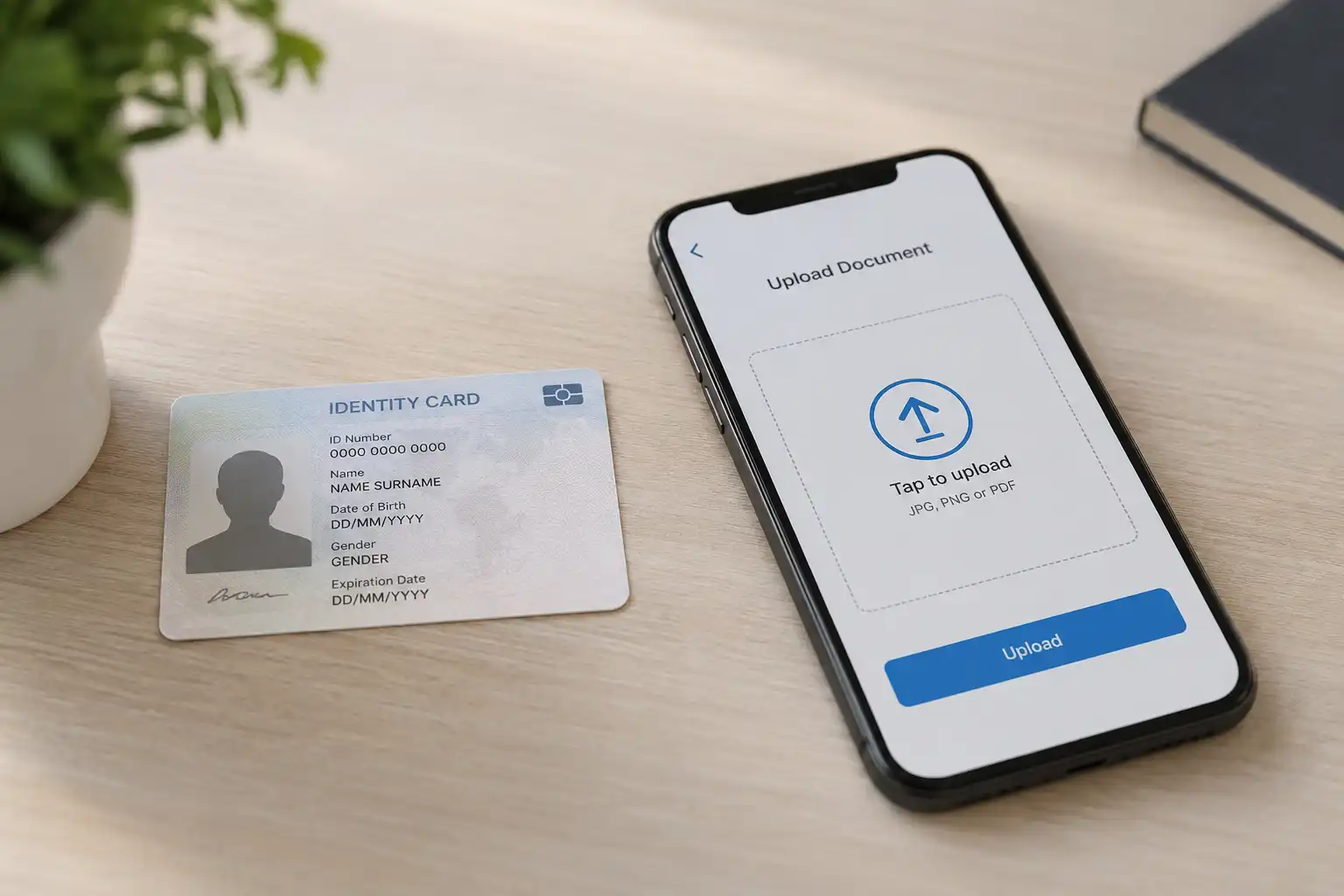
First, proof of identity. This is a government-issued photo document, a passport or driving licence, used to confirm who you are and that you are over 18. Second, proof of address. This is typically a recent utility bill or bank statement, usually dated within the last few months, showing your name and address to confirm where you live. Third, proof of payment method. If you deposited by card, this might be a photo of the card with sensitive digits masked; if by e-wallet, a screenshot of the account; the purpose is to confirm the payment instrument belongs to you and prevent third-party funding.
The practical failure points are mundane but costly. Documents get rejected for being blurry, cropped, expired, or for showing a name or address that does not exactly match your account details. A utility bill that is six months old when the operator wants three, a driving licence photographed at an angle that obscures a corner, a name entered with a middle initial on the account but not on the document, any of these triggers a rejection and a fresh round of uploads that adds days. Submit clear, current, fully visible documents whose details match your registration precisely, and verification usually clears in a single pass rather than the frustrating back-and-forth that catches unprepared players.
How KYC interacts with payout holds
This is the section that connects the process to the thing players actually care about, getting paid. KYC is the most common legitimate reason a withdrawal is held, and separating a verification hold from a genuine problem is essential to responding correctly.
When you request a withdrawal from an unverified or partially verified account, the payout cannot proceed until verification completes. The money is not lost or refused; it is paused pending the check. This is a normal hold, and the cure is simply to complete verification promptly. The danger is mistaking a routine verification hold for a refusal and either panicking or escalating prematurely, when the resolution is to upload the requested documents and wait. Equally, you should be alert to the difference between a reasonable verification request and one that keeps moving the goalposts, repeated requests for ever-more documents after you have supplied the standard set can signal a stalling tactic rather than a genuine check.
The wider enforcement environment is why verification has tightened across the whole segment, including offshore. In the current financial year the UK regulator’s specialist team referred around 200,000 URLs to search engines and tracks the traffic of more than 1,000 illegal operators, part of a broader squeeze on the unlicensed market. The offshore share of UK play has climbed sharply, with Yield Sec’s analysis putting the black market’s share at almost 9 percent in 2025 against 0.43 percent in 2020 (Frontier Economics, using a different methodology, puts the figure closer to 2 percent of online stakes), and that growth draws scrutiny that pushes even offshore operators toward more rigorous KYC to manage their own risk. For you, the takeaways are practical: verify early, supply documents that match exactly, treat a verification hold as routine rather than refusal, but watch for goalpost-moving that crosses into a genuine dispute. If a hold stops behaving like ordinary verification and starts looking like a refusal, understanding how Betti complaints and disputes actually resolve is the next thing you will want to know.
Prepared by the Betti Casino editorial staff.