Betti Casino KYC: What Verification Asks For and When It Triggers
 Available in GB
The email that arrives at the worst possible moment
There is a particular flavour of player frustration I have watched play out hundreds of times. Someone wins, requests a withdrawal, and only then receives a message asking them to verify their identity by uploading documents. The timing feels suspicious, almost punitive, as if the casino conjured an obstacle the instant money was about to leave. It is not a trick, and understanding why it happens removes most of the anxiety around it. Know-your-customer verification at Betti, as at every operator, is routine, predictable, and far less sinister than its timing makes it feel.
Know-your-customer, universally shortened to KYC, is the process by which an operator confirms you are who you say you are, that you are of legal age, and that your funds are legitimate. It exists for anti-money-laundering reasons and is standard across the entire gambling industry, regulated and offshore alike. The reason it so often surfaces at withdrawal time rather than at sign-up is structural, not malicious, and once you see the logic you can pre-empt the whole thing.
What follows demystifies the process: when KYC typically triggers and why it clusters around withdrawals, exactly what documents the check usually asks for, and how verification interacts with payout holds so the cause of any delay is legible. An opaque, anxiety-inducing request turns into a checklist you handle calmly, ideally before it ever lands. A player who verifies early almost never experiences KYC as a problem at all.
Our top casino picks for the UK
- BritsinoBonus: Welcome Package – Get your £2,200 + 2,000 FS · Payout speed: 1-3 business days
- ZombillionBonus: Welcome Pack 250% up to £4000 + 200 FS · Payout speed: 1-3 business days
- EvoSpinBonus: 125% up to €2500 + 125 Free Spins · Payout speed: 1-3 business days
- Revery PlayBonus: 100% up to€1,000+ 100 FS · Payout speed: 1-3 business days
- NightLuckBonus: Welcome Pack + 805% Up To 6400€ + 280 FS · Payout speed: 1-3 business days
- DieselwinBonus: Welcome Pack 250% up to £4000 + 200 FS · Payout speed: 1-3 business days
When KYC actually triggers
Verification does not spring at players unpredictably. It fires on a small, well-defined set of events, and mapping those events onto your own account lets you decide the timing rather than having it decided for you.
Three triggers account for the overwhelming majority of KYC requests. The first, and by a wide margin the most common, is the first withdrawal request on an account: many operators let you sign up and fund a balance with minimal friction, then run the full verification only when money is actually about to leave the platform. The second is crossing a cumulative deposit or withdrawal threshold, where the total flow through the account exceeds a stated figure and additional checks kick in as a matter of policy. The third is any signal the operator’s risk system reads as unusual, a step-change in deposit size, a mismatch between account details and payment source, or a play pattern the fraud engine associates with multi-accounting or bonus abuse.
The reason the check clusters at withdrawal rather than at sign-up is a deliberate design choice by operators, and it is worth understanding because it explains most of the frustration around KYC. Requiring documents at registration would put off a meaningful share of casual sign-ups; deferring the check until money is on the way out satisfies the anti-money-laundering obligation at the last moment consistent with regulation without dampening initial conversion. From the operator’s spreadsheet this trade-off is obvious. From the seat of a player who has just won and is now being asked for a passport photo before payout, it reads as an ambush at the finish line. The single practical lever you have is timing: upload your documents and complete the check within the first days of registration, well before any withdrawal request, and the whole thing simply never happens at the wrong moment.
The documents you will be asked for
Fortunately for pre-emptive players, the actual document list is more predictable than the process wrapped around it. Casinos across the market ask for essentially the same evidence, and gathering it in advance is the single most effective thing you can do to make verification a one-pass exercise instead of a drawn-out back-and-forth.
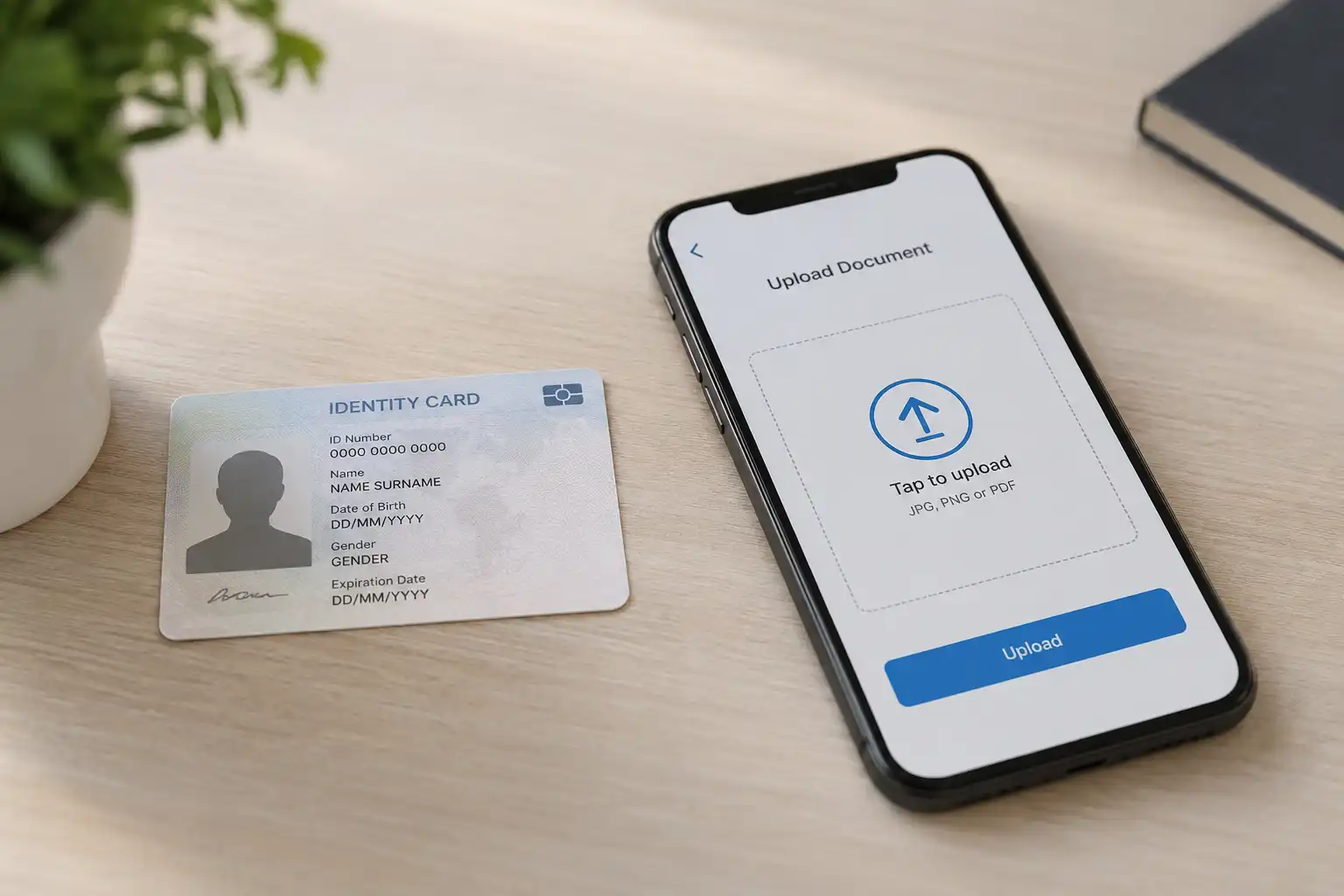
The requests fall into three fixed categories. Proof of identity comes first: a government-issued photo document, typically a passport or driving licence, used to confirm both that you are who you say you are and that you meet the legal minimum age. Proof of address comes second: usually a utility bill or bank statement dated within the operator’s acceptance window, most often the previous three months, printed with your registered name and address so the platform can match address to account. Proof of payment method comes third: for a card deposit this tends to be a photograph of the card with the middle digits and the CVV masked; for an e-wallet a screenshot showing the account belongs to the same registered person; the purpose in every case is confirming that the money route into and out of the account is yours, not a third party’s.
Where players actually lose time is in the mundane failure modes, and every one of them is avoidable in advance. Documents get bounced for being blurry, for showing a cropped edge, for being past the operator’s freshness window, or for carrying a name spelled fractionally differently from the one on the account, a middle initial included on one side and dropped on the other is enough to fail a match. A utility bill six months old when the operator accepts three, a driving licence photographed at an angle that clips a corner, an address that reads slightly differently on the bill and the registration form, each one costs another upload cycle and another day or two of waiting. Prepare the pack once, at the highest quality your phone or scanner produces, with all four corners visible and the details reading identically to your account, and the check typically clears on the first attempt.
How KYC interacts with payout holds
Nothing about KYC matters until it collides with a payout, which is where the whole process becomes concrete for players. Verification is the single most common legitimate reason a withdrawal sits on hold at any casino, and knowing how to read the difference between a routine verification pause and a genuine dispute is essential for responding correctly to either.
When you submit a withdrawal from an account that has not fully cleared KYC, the payment cannot be released until the check completes; the request enters a paused state, not a refused one, and the money is neither confiscated nor at risk. Treated correctly, this hold ends the moment your final document is approved. The real failure mode is misreading a verification pause as a payout refusal and either panicking or escalating into a formal complaint before the process has actually stalled. The reverse mistake is also worth guarding against, however: a legitimate verification hold has a bounded shape, three or four documents from the standard list, reviewed, approved. When the operator keeps returning with fresh requests for additional evidence, adjacent evidence, or documents the standard KYC framework does not normally require, the hold is beginning to behave less like verification and more like a stalling manoeuvre, and that shift deserves attention.
The reason verification pressure has intensified across the whole segment, offshore included, is the broader enforcement climate the industry now sits inside. In the current financial year the UK regulator’s specialist team referred around 200,000 URLs to search engines and tracks the traffic of more than 1,000 illegal operators, part of a sustained squeeze on the unlicensed market. The offshore share of UK online play has expanded sharply over the same window, with Yield Sec’s analysis putting the black market’s share at almost 9 percent in 2025 against 0.43 percent in 2020 (Frontier Economics, using a different methodology, puts the figure closer to 2 percent of online stakes), and the rising visibility of that segment draws scrutiny that pushes even offshore casinos toward tighter KYC discipline for their own risk management. For a player, the working checklist is short: verify proactively soon after registration, supply documents whose details match your account exactly, treat a normal verification hold as routine paperwork rather than payout refusal, and watch for the pattern shift that signals goalpost-moving. If a hold stops behaving like verification and starts looking like a refusal in disguise, understanding how Betti complaints and disputes actually resolve is the next thing worth reading.
Can I play before completing KYC at Betti?
Usually yes. Most offshore operators let you register and deposit with minimal verification, then run full KYC when you first request a withdrawal or cross a deposit threshold. This minimises sign-up friction while satisfying anti-money-laundering requirements before funds leave. The catch is that deferred verification surfaces at withdrawal time, which feels like an obstacle. Completing KYC proactively soon after registering avoids that delay entirely.
Why was my verification rejected?
The most common reasons are mundane: documents that are blurry, cropped, expired, or whose name or address does not exactly match your account details. A utility bill older than the operator accepts, a photo with an obscured corner, or a name mismatch all trigger rejection and a fresh upload round. Submit clear, current, fully visible documents that match your registration precisely, and verification usually clears in a single pass.
Written by the editors at Betti Casino.